AN INTERACTIVE FIELD GUIDE TO WORD GEOMETRY
king − man + woman ≈ queen — and other arithmetic a corpus lets you do with meaning
GloVe 6B · 100 dimensions · three.js · no servers harmed
Every word below is a point in a 100‑dimensional space, learned from 6 billion tokens of Wikipedia 2014 and Gigaword 5 news text. Words that appear in similar contexts land near each other: king drifts toward throne, paris toward france.
The strange part: some relationships survive as approximately reusable offsets. king − man + woman lands near queen — not because the space contains royalty as a clean axis, but because the corpus happened to encode that regularity. This page lets you push those vectors around with sliders, then uses the same math on a harder question: what associations did the 2014-era corpus freeze in about the wealthy?
Pick three words, weight them between −2 and +2 — negative weights reverse a vector's contribution. The glowing dot is your equation's answer, live in the word-field. Drag to orbit; hover or tap any dot to see its word.
How to read the plot — colored markers and dashed lines pin your three input words; the pulsing dot is the equation's result. Similarity is computed in the full 100‑dimensional space; the 3D view is a PCA projection, so apparent on-screen distances can mislead. Dot colors are decorative print texture, not clusters.
PLAY THE COMPANION GAME SEMANTLE MATH → guess a secret word using nothing but vector equationsMEANING HAS A TIMESTAMP
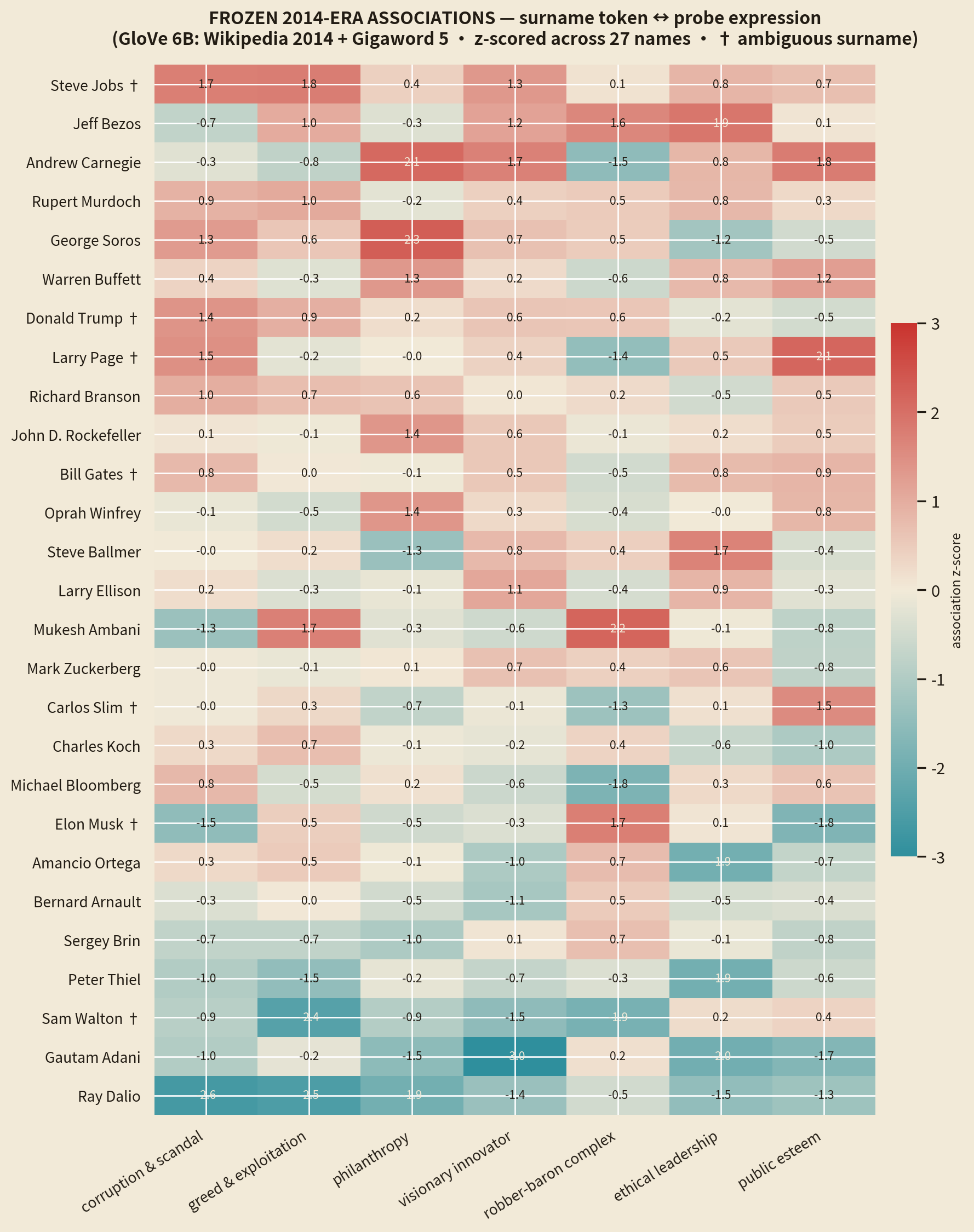
These vectors are frozen outputs of 6 billion tokens from Wikipedia 2014 and Gigaword 5 — trained once and never updated. We scored 27 surname tokens associated with wealthy public figures against seven probe expressions — some simple (corruption+fraud+scandal), some compound, with subtraction poles (monopoly+greed+exploitation−fair−honest) — then contrasted those association scores with ratings from a 2026 language model (Kimi, Moonshot AI; single hand-rated pass per name; both panels z‑scored across the 27 names).
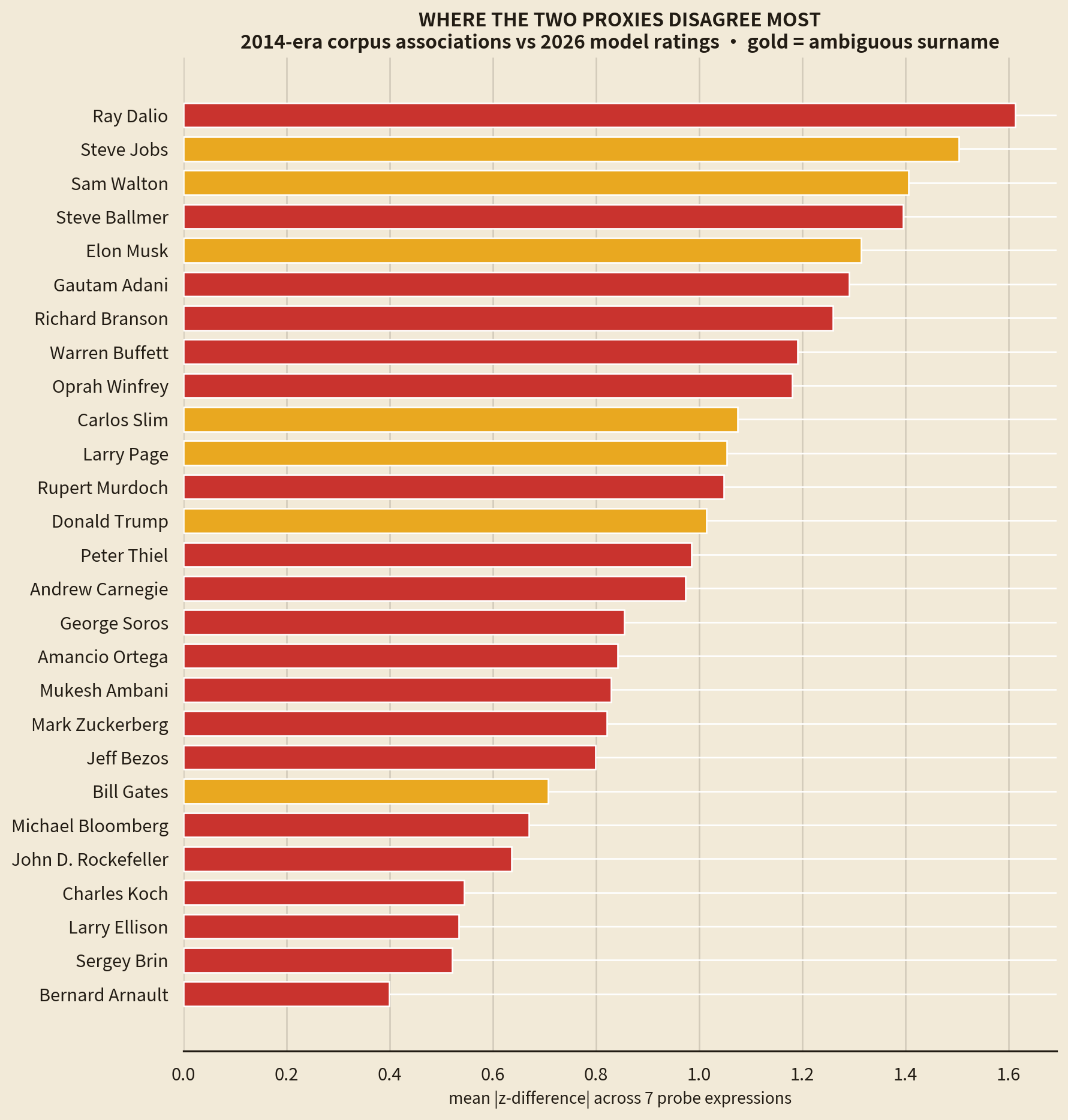
Because these are two different instruments, the gaps below show disagreement between proxies — not measured change in public opinion. Where they diverge, sometimes the culture moved; sometimes the instrument is simply wrong. Telling those apart is the game.
The standouts split into two kinds. Plausible zeitgeist shifts: Gautam Adani (+2.8σ corruption) is nearly invisible in the 2014 corpus; the modern proxy — shaped by the 2023 Hindenburg affair — is not. Carlos Slim's robber-baron reading (+2.5σ) is far stronger in the modern proxy. And instrument artifacts: “jobs” means employment, so the Steve Jobs token lives in labor-market space regardless of anyone's opinion of the man. The most stable profiles — Arnault, Brin, Ellison, Koch — score nearly the same on both instruments.
All of these are readings the charts suggest, not findings they prove.
GloVe 6B (Wikipedia 2014 + Gigaword 5), 100d, lowercase HF mirror. Playground: a 1,457-word display vocabulary, PCA-projected to 3D for display; similarity is always computed in the full 100d space.
Each imported vector is L2-normalized before use. An equation is a weighted sum, re-normalized; score = cosine similarity. A negative term subtracts one vector's contribution — it does not cleanly erase a concept.
Cosine association is co-occurrence, not accusation. Surname/common-word collisions pollute flagged rows. The “modern” panel is a single model's hand-rated estimate (Kimi, 2026-08-14), not polling — both panels are z-scored across the 27 names.